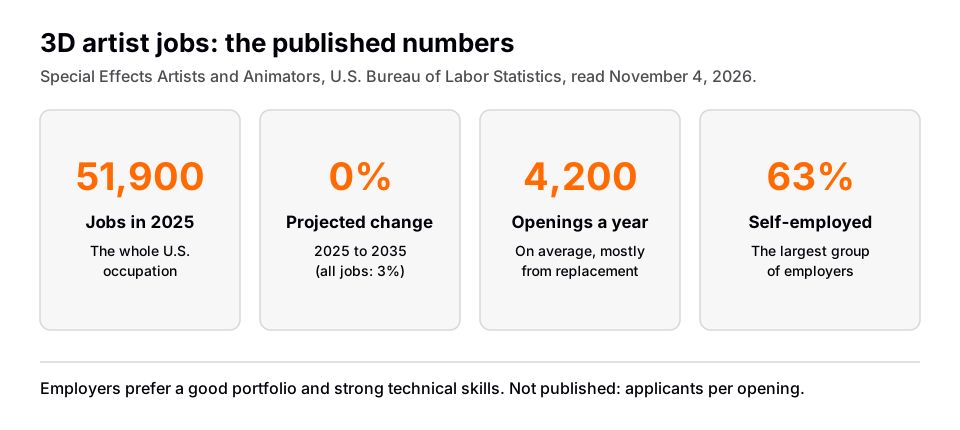
3D artist jobs sit mostly under one government category, Special Effects Artists and Animators, and employers in that field usually hire on a good portfolio and strong technical skills. The U.S. Bureau of Labor Statistics (BLS) counted about 51,900 jobs in the category in 2025 and projects little or no change in employment from 2025 to 2035, so getting hired is about showing finished work, not about waiting for a boom.
This guide separates what primary sources publish from what nobody publishes. It covers what a 3D artist job is, what the BLS and O*NET say about pay, education and employers, where people actually look for work, and a step-by-step plan for going from learner to applicant. Every number is dated and linked. Where a source does not publish a figure, we say so instead of guessing. We also point to what a 3D artist portfolio has to show, because that is the part you control.
What a 3D artist job is
A 3D artist makes three-dimensional models, images and animation with software. The BLS describes the occupation as people who create two- and three-dimensional models, moving images and visual effects for television, movies, video games and other media. The daily work, per the BLS, includes using computer programs to build graphics and animation, working in teams, researching projects and revising work based on feedback.
The job titles vary. O*NET, the U.S. Department of Labor's occupation database, lists "3D Artist" and "3D Animator" as sample titles for this occupation (code 27-1014.00), next to Animator, Digital Artist, Graphic Artist, Motion Graphics Artist and Multimedia Producer. If you search for "3D artist job" or "jobs 3D artist", expect postings with many different names for similar work: environment artist, character artist, hard surface artist, product visualization artist, motion designer. Read the requirements, not the title.
One caveat. The BLS and O*NET group many specialties into one occupation. Their figures describe the whole group. They do not break out hard surface modelers, texture artists or lighting artists, and they do not break out people who use Blender.
What the official numbers say
These figures come from the BLS Occupational Outlook Handbook page for Special Effects Artists and Animators, which showed a last-modified date of October 29, 2026 when we read it on November 4, 2026.
| Measure | Published figure | What it means |
|---|---|---|
| Jobs, 2025 | About 51,900 | Size of the whole occupation in the U.S. |
| Projected change, 2025 to 2035 | 0%, a change of -100 jobs | Employment is projected to be flat; the all-occupations figure is 3% |
| Openings per year | About 4,200 on average | BLS says most come from workers who transfer or leave the labor force |
| Median pay, May 2025 | $102,030 per year | The middle of the whole occupation, not an entry-level wage |
| Lowest 10% and highest 10% | Under $58,600 and over $177,110 | The spread is wide |
| Typical entry education | Bachelor's degree | No related work experience or on-the-job training listed |
Read the table carefully. A flat projection does not mean no jobs. The BLS expects around 4,200 openings a year, mostly from replacement of people who leave or change occupations, so jobs open even when the total does not grow. It also does not mean the field is easy to enter. The BLS does not publish how many applicants compete for those openings, and neither do we.
The BLS also states that artificial intelligence may reduce demand, because it can complete some animation and special effects tasks more quickly. It says demand is supported by animation and visual effects in video games, movies and television. Both statements are on the same page, and both are worth taking seriously. If you want the pay detail by industry and what it does and does not tell you, see 3D artist salary.
Where 3D artist jobs are
The BLS lists the largest employers of the occupation in 2025: self-employed workers at 63%, motion picture and video industries at 10%, software publishers at 7%, computer systems design and related services at 4%, and arts, entertainment and recreation at 3%. The BLS also says many artists and animators work in offices, and others work from home.
The biggest number there is the first one. Most people in this occupation are self-employed, which means freelance work and small studios are not a side path. They are the main path. If you only look for staff positions at big studios you are looking at a minority of the field. We cover that route in freelance 3D artist jobs, and the home-based side in remote 3D artist jobs.
The industries are also wider than the film and game studios people think of first. Software publishers and computer systems design appear in the BLS list next to motion picture and video. The Blender Manual, read November 4, 2026, says professionals, hobbyists and studios use Blender for animations, game assets, motion graphics, TV shows, concept art, storyboarding, commercials and feature films. That shows what the software is used for. It does not tell you which employers hire.
What employers look for
The BLS answer is short: a good portfolio and strong technical skills. It lists artistic talent, communication skills, computer skills, creativity and time-management skills as important qualities. The typical entry-level education is a bachelor's degree in computer graphics, animation, fine arts or a related field.
O*NET adds some nuance. It places the occupation in Job Zone Four, where most occupations require a four-year degree but some do not, and its respondents reported that some jobs in the group ask for some college or only a high school diploma. So a degree is the typical route, not a legal requirement, and the portfolio is what carries the argument.
On software, be careful. O*NET lists technology skills for the occupation, with examples such as Autodesk 3ds Max Design, Adobe After Effects, Pixar RenderMan Studio and Unity. When we read the page on November 4, 2026, Blender was not among the examples it displayed. That does not mean employers reject Blender. It means you should read each posting's required tools. The concepts carry across programs: the Blender Manual calls UV maps, materials, shaders and meshes the media of the digital artist, and says understanding them even broadly helps you use Blender well. If you are choosing what to learn first, entry level 3D artist jobs goes deeper on what beginners are asked for.
How to get hired as a 3D artist, step by step
No source can promise a hire. What follows is the order of work that matches what the BLS says employers prefer.
- Pick one specialty. A portfolio that is clearly about hard surface models, product visuals, environments or characters is easier to judge than one that tries to be everything. Choose by looking at postings you would actually want and noting the skills they list.
- Learn the pipeline in order. Most 3D work moves through modeling, UV mapping and texturing, lighting and rendering, and sometimes animation. The Blender Manual says Blender supports the entire 3D pipeline: modeling, rigging, animation, simulation, rendering, compositing, motion tracking and video editing. You do not need all of it. You need the parts your specialty uses.
- Finish pieces, do not just practice. Take a few projects all the way to a final render. A finished piece shows modeling, materials, lighting and presentation together, which is what a reviewer wants to see.
- Put the work online. The BLS notes that many artists and animators post their creative work on the Internet, and that popular work may lead to future employment or freelance work. A portfolio site, an ArtStation profile and a LinkedIn profile that all show the same best pieces is enough to start.
- Read postings and match them. Open several postings for the role you want. Write down the repeated requirements (software, specialty, years of experience, whether a degree is required). Close the gaps with a project, not a promise.
- Apply, then keep making work. Send the portfolio link first, tailor a short note to the role, and keep posting new pieces while you wait. Track every application so you can follow up.
- Take small paid jobs. Because the BLS shows 63% of the occupation is self-employed, a freelance project is a normal first credit, and it gives you a client to ask for a reference.
After step 3 you should have at least one piece you would be comfortable showing to a stranger. If you do not, the fix is more finishing, not more tutorials.
Where to look for 3D artist job listings
These are the places where listings are published. We read their help or category pages on November 4, 2026. We do not name employers, because openings change daily and we cannot verify a listing for you.
- LinkedIn Jobs. LinkedIn's help page on job alerts says a member can have at most 20 job alerts at once, set to daily or weekly delivery by email, app notification or both.
- Indeed. Its help center covers searching by keyword and location, and filtering by remote.
- ArtStation Jobs. ArtStation's help center says a full-time listing is posted for 45 days and a freelance listing for 15 days, so a listing older than that has expired. We could not load the live jobs page ourselves, so we cannot describe its filters.
- Blender Artists Jobs. The community's Jobs category has a Paid Work area for full-time, part-time and freelance positions and a separate area for volunteer or deferred-pay work, and it describes itself as heavily moderated.
- Studio and company careers pages. Blender's own careers page, for example, lists engineering roles, says in one place that there are no open positions currently, and invites speculative applications. It shows no date. A careers page without a date is a reason to confirm by email before you plan around it.
Whichever you use, confirm every posting on the employer's own site, and be wary of anything that asks for money before an interview.
Learn this in order with The Blender Launchpad
If Blender is your tool, the slow part is deciding what to learn next. The Blender Launchpad is a members app with a roadmap of hand picked, free YouTube lessons in six stages: Blender basics, hard surface modeling, UV and PBR texturing, studio lighting and rendering in Cycles and EEVEE, animation, and Geometry Nodes. Stage 1 assumes you have never opened Blender. It is a curated playbook, not a set of original video lessons.
It also includes three bonuses that line up with the steps above: niche and portfolio building, LinkedIn branding, and a library of 1,000+ CC0 assets, HDRIs and textures that are free for commercial use. It is a path and a place to build your portfolio, not a hiring service. It is one payment with no subscription.
Questions people also ask
What is a 3D artist job?
It is work making 3D models, images, animation or visual effects for games, film, television, advertising and other media. The BLS groups it with animators under Special Effects Artists and Animators.
Do you need a degree for 3D artist jobs?
The BLS lists a bachelor's degree as the typical entry-level education, and O*NET notes that some jobs in the occupation do not require one. In both cases employers usually prefer a good portfolio and strong technical skills.
Are there 3D artist jobs without experience?
The BLS lists no related work experience as required for the occupation, but it does not publish how many entry-level openings exist. Treat finished portfolio pieces and small freelance credits as your experience.
Where do I find 3D artist job listings?
Use LinkedIn Jobs, Indeed, ArtStation Jobs, the Blender Artists Jobs category and studio careers pages, and set alerts. Check each listing on the employer's own site before you apply.
Is Blender enough to get a 3D artist job?
Blender covers the full 3D pipeline, per its manual, but employers list their own required tools. Read the posting, and show finished work made with the tools it names.
How we checked this
We read these pages on November 4, 2026. We did not run Blender for this article, and we did not check any individual job listing.
- U.S. Bureau of Labor Statistics, Occupational Outlook Handbook: Special Effects Artists and Animators (last modified October 29, 2026)
- O*NET OnLine: 27-1014.00, Special Effects Artists and Animators
- Blender Manual 5.2 LTS: About Blender
- LinkedIn Help: job alerts
- Indeed Help: Searching for remote jobs
- ArtStation Help: Full-time and freelance job listings
- Blender Artists: Jobs category
- Blender: Jobs