
A 3D artist salary in the United States has one official benchmark: the U.S. Bureau of Labor Statistics (BLS) reports median pay of $102,030 a year, or $49.06 an hour, for special effects artists and animators in May 2025. The lowest 10 percent earned less than $58,600 and the highest 10 percent earned more than $177,110, so the spread is wide, and the median describes the whole occupation, not a beginner.
This guide gives the published figures with their dates, then says what they leave out, because that part matters more than the headline. The BLS wage data does not include self-employed workers, who are 63% of the occupation, and it does not break out entry level pay, Blender users or any one specialty. We give no estimate for those. We also link the related guides on entry level 3D artist jobs and freelance 3D artist jobs, since those are the two cases the median does not cover.
What the BLS publishes about 3D artist pay
The BLS groups 3D artists with animators under the title Special Effects Artists and Animators. O*NET, the U.S. Department of Labor's occupation database, lists "3D Artist" and "3D Animator" among the sample job titles for this occupation (code 27-1014.00) and shows the same 2025 wages. We read both on November 4, 2026. The BLS Occupational Outlook Handbook page was last modified October 29, 2026.
| Measure | Published figure | What it means |
|---|---|---|
| Median pay, May 2025 | $102,030 a year, $49.06 an hour | Half the workers earned more, half less |
| Lowest 10 percent | Less than $58,600 a year | One in ten earned below this |
| Highest 10 percent | More than $177,110 a year | One in ten earned above this |
| Typical entry-level education | Bachelor's degree | No related work experience or on-the-job training listed |
The BLS defines the median wage as the wage at which half the workers in an occupation earned more than that amount and half earned less. It says most special effects artists and animators work a regular full-time schedule, with extra hours as deadlines approach. The wage data come from the BLS Occupational Employment and Wage Statistics (OEWS) survey.
3D artist salary by industry
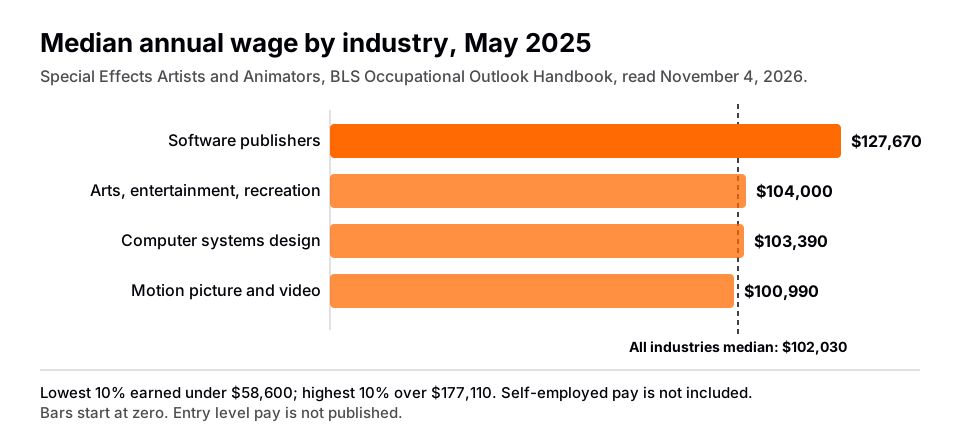
The BLS page lists median annual wages for the four industries that employ the most people in the occupation, for May 2025.
| Industry | Median annual wage | Share of the occupation's jobs |
|---|---|---|
| Software publishers | $127,670 | 7% |
| Arts, entertainment, and recreation | $104,000 | 3% |
| Computer systems design and related services | $103,390 | 4% |
| Motion picture and video industries | $100,990 | 10% |
The shares are the BLS's 2025 employer distribution. Self-employed workers are the largest group at 63% and have no industry wage in this table. The four industries are close to each other except software publishers, but the page we read gives no reason and no medians for other industries.
What the median leaves out
Read these limits before you use the number to plan anything.
- Self-employed pay is not included. The BLS page says its wage data do not include pay for self-employed workers because the OEWS survey does not collect it. Since self-employed workers are 63% of the jobs, the median describes employees, not the biggest group.
- Entry level pay is not published. The BLS gives a median and a range for the whole occupation, not by experience. It says earnings within an occupation vary by experience, responsibility, performance, tenure and geographic area.
- Specialty and software are not broken out. The figures cover all special effects artists and animators. There is no separate number for hard surface modelers, product visualization artists or Blender users.
- Location is not on the page. The BLS says earnings vary by geographic area, but we found no state figures on the Outlook Handbook page.
- The outlook is flat. The BLS projects employment to show little or no change from 2025 to 2035, with about 4,200 openings a year, mostly from workers who leave the occupation. It adds that some animation and special effects tasks can be completed more quickly with artificial intelligence, which may reduce demand. The page we read gives no pay forecast.
So the median tells you what employed artists in the field earned in one year, nothing more. It does not tell you what a first job pays, and we will not guess a figure from it.
How other creative jobs compare
The BLS page lists similar occupations with their own 2025 median pay. These are different jobs with different duties, so use them for context only.
| Occupation (BLS) | 2025 median pay | Typical entry education |
|---|---|---|
| Art Directors | $114,850 | Bachelor's degree |
| Web Developers and Digital Designers | $99,520 | Bachelor's degree |
| Film and Video Editors and Camera Operators | $75,100 | Bachelor's degree |
| Graphic Designers | $62,960 | Bachelor's degree |
| Craft and Fine Artists | $55,290 | See How to Become One |
How to find pay for a specific job
- Read the posting. If a posting states a pay range, that is the employer's own figure for that job, which beats any average. If it does not, ask early in the process.
- Use the BLS OEWS tables for place and industry. The OEWS tables page lists May 2025 files for national, state, metropolitan and nonmetropolitan areas and for industries. We could not read the occupation rows ourselves, so we quote none. Look up 27-1014, Special Effects Artists and Animators.
- Match the role to the data. A role in a software publisher, a film studio and an agency fall in different industry rows, so compare like with like.
- If you freelance, price the project. Base it on your time, the complexity, the revision rounds and the use, as freelance 3D artist jobs explains.
- Build the portfolio first. The BLS says employers usually prefer a good portfolio and strong technical skills. See 3D artist portfolio.
For jobs, openings and where employers are, see 3D artist jobs: what the data says and how to get hired.
Learn this in order with The Blender Launchpad
Pay follows the work you can show, so the practical question is what to learn and in what order. The Blender Launchpad is a members app with a roadmap of hand picked, free YouTube lessons in six stages: Blender basics, hard surface modeling, UV and PBR texturing, studio lighting and rendering in Cycles and EEVEE, animation, and Geometry Nodes. Stage 1 assumes you have never opened Blender. It is a curated playbook, not original video lessons.
Its bonuses cover niche and portfolio building, LinkedIn branding, and 1,000+ CC0 assets, HDRIs and textures that are free for commercial use. It does not promise a job or an income. It is one payment with no subscription.
Questions people also ask
How much does a 3D artist make?
The BLS reports median pay of $102,030 a year for special effects artists and animators in May 2025, with the lowest 10 percent under $58,600 and the highest 10 percent over $177,110. The figure excludes self-employed workers.
What is the entry level 3D artist salary?
The BLS does not publish pay by experience level for this occupation, so we cannot give a figure. It says earnings vary by experience, responsibility, performance, tenure and geographic area.
Do freelance 3D artists earn more than employees?
No source we read compares them. The BLS wage data leave out self-employed workers, and 63% of the occupation is self-employed.
Is a degree required for a higher 3D artist salary?
The BLS lists a bachelor's degree as typical entry education but does not publish pay by education. It says employers usually prefer a good portfolio and strong technical skills.
How we checked this
We read these pages on November 4, 2026. We did not run Blender for this article, and we did not read any job posting, salary site or survey other than the official pages below. We could not read the OEWS occupation rows, so every figure here comes from the Outlook Handbook and O*NET pages.
- U.S. Bureau of Labor Statistics, Occupational Outlook Handbook: Special Effects Artists and Animators (last modified October 29, 2026), including its pay, work environment, job outlook and similar occupations sections
- O*NET OnLine: 27-1014.00, Special Effects Artists and Animators
- U.S. Bureau of Labor Statistics: OEWS Tables, May 2025 (index of data files)