A hard surface modeler is a 3D artist who builds rigid, man-made objects, such as vehicles, machines, weapons, props and buildings, with clean shapes and believable edges. To become one, you learn polygon modeling in a program such as Blender, practice on mechanical subjects, and build a portfolio of finished pieces, because the U.S. Bureau of Labor Statistics says employers in this field look for a good portfolio of work.
"Hard surface modeler" is a working title, not an official occupation. This guide sticks to primary sources: the BLS, the Blender Manual and software makers' own pages. It does not quote salaries or job counts, because none of those sources break this role out. If you want the basics of the craft first, read what hard surface modeling is.
What a hard surface modeler does
The job is to turn a design or reference into a finished 3D model of a manufactured object. Software makers describe the subjects the same way. Maxon's ZBrush help lists armor, weaponry and other props, and complete robots and all kinds of mechanical shapes as hard surface work (Maxon ZBrush help, read November 4, 2026). An Adobe Substance 3D guide says modeling buildings is sometimes known as hard-surface modeling (Adobe, read November 4, 2026).
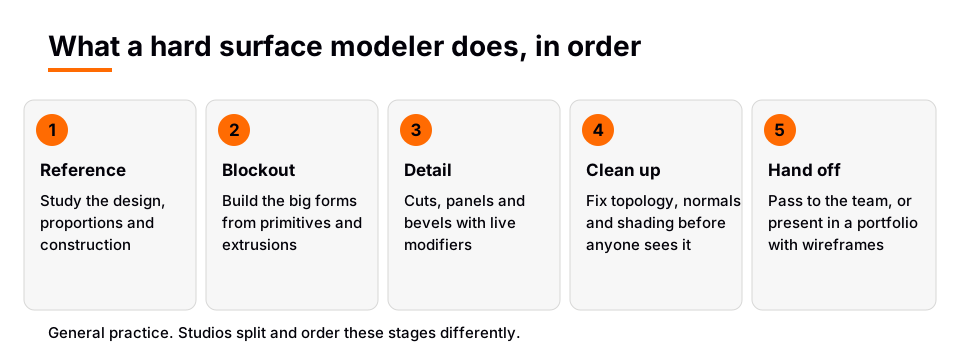
In day-to-day terms, the stages in the figure are a fair description: study the reference, block out the main shapes, add detail with cuts and bevels, clean the mesh and its shading, then hand the model on or present it. What happens after the model is handed on, such as texturing or rigging, depends on the team. The BLS says animators and artists often work in teams and revise their work based on feedback, so expect the model to change after it leaves your hands.
Sources: ZBrush help · modeling buildings is sometimes known as hard-surface modeling
Where the role fits in official data
The BLS Occupational Outlook Handbook groups 3D modeling work under Special Effects Artists and Animators, who it says create two- and three-dimensional models and animation (BLS, Special Effects Artists and Animators, last modified October 29, 2026, read November 4, 2026). We searched that page for "hard surface," "modeler" and "modeling" and found none of them. So the BLS does not publish anything about hard surface modelers as a separate group, and neither do we. For the wider picture of 3D jobs, see 3D artist jobs.
Sources: BLS, Special Effects Artists and Animators
Skills a hard surface modeler needs
The table separates skills the Blender Manual or BLS documents from skills that are our own general reading of the work.
| Skill | What it means | Source |
|---|---|---|
| Polygon modeling and topology | Building clean meshes from vertices, edges and faces. The manual notes quads are preferred for subdivision modeling. | Blender Manual |
| Edge treatment | Beveling edges so they catch light. The manual notes nothing in real life is infinitely sharp. | Blender Manual |
| Shading and normals | Keeping flat panels flat and curves smooth, with tools such as Smooth by Angle and Weighted Normal. | Blender Manual |
| Non-destructive modifiers | Mirror, Boolean, Bevel and others kept live so the design stays editable. | Blender Manual |
| Teamwork and feedback | Working with others and revising from notes. Communication is on the BLS list of important qualities. | BLS |
| Reading references | Judging proportions, panel gaps and construction from drawings or photos. | General logic |
The BLS also lists artistic talent, computer skills, creativity and time-management skills as important qualities for the wider occupation. For the tool-by-tool Blender workflow that covers the first four rows, see hard surface modeling in Blender.
Software hard surface modelers use
There is no single required program. Blender's manual says professionals, hobbyists and studios use it for animations, game assets, motion graphics, TV shows, concept art, storyboarding, commercials and feature films (Blender Manual 5.2 LTS, About Blender). Maxon's ZBrush has features designed for hard surface sculpting, built on its Planar, Trim and Polish brushes. A studio's own job posting is the only reliable list of the tools it expects, so read the requirements before you decide what to learn.
The skills carry across programs: topology, bevels, normals and construction logic are the same ideas in any package.
Sources: Blender Manual 5.2 LTS, About Blender
Education and experience
For the wider occupation, the BLS says special effects artists and animators typically need a bachelor's degree in a field such as computer graphics or art, and that employers look for workers who have a good portfolio of work. The page does not make a degree the only route and does not say how any one person gets hired. Treat the degree as one path, and the portfolio as the part you control directly.
Build a hard surface portfolio
The BLS notes that many special effects artists and animators put their creative work on the Internet. The advice below is our own, based on what a reviewer needs to judge model work, not a standard. Our broader guide to a 3D artist portfolio covers presentation.
- Show three to five finished pieces. A few complete models beat many half-finished ones.
- Keep one clear subject area. A portfolio of vehicles, props or sci-fi environments is easier to judge than a mix.
- Show the mesh. Pair each final render with a clean wireframe view so a reviewer can see the topology and the bevels.
- Show how it was built. A short breakdown of blockout, cuts and shading proves the model was not luck.
- Add materials and lighting. A well-lit render shows edge highlights and surface detail.
- Say what you used and what you made. If you started from a reference, credit it. If you used a free model, say so.
How to become a hard surface modeler, step by step
- Learn Blender basics. Navigation, selection, Edit Mode and modifiers.
- Learn the hard surface toolset. Extrude, Inset, Loop Cut, Bevel, Boolean, Mirror and normal tools, in that order.
- Finish three pieces. Choose subjects from a field you like, such as vehicles or props.
- Publish them. A portfolio page plus a professional profile with the same pieces is enough to start.
- Read postings. Note the repeated requirements and close gaps with a project, not a promise.
- Apply or take small jobs. Our guide on entry level 3D artist jobs goes further.
No guide can promise a job, including this one. The aim of the steps above is to leave you with finished work to show and a clear idea of what each posting asks for.
Learn this in order with The Blender Launchpad
The Blender Launchpad is a members app with a roadmap of hand picked, free YouTube lessons in six stages: Blender basics, hard surface modeling, UV and PBR texturing, studio lighting and rendering, animation, and Geometry Nodes. Stage 1 assumes you have never opened Blender, and Stage 2 is hard surface modeling.
It also includes three bonuses that match the portfolio steps above: niche and portfolio building, LinkedIn branding, and 1,000+ CC0 assets, HDRIs and textures that are free for commercial use. It is a curated playbook, not original video lessons, and it is not a hiring service. It is one payment with no subscription.
Questions people also ask
What does a hard surface modeler do?
A hard surface modeler builds 3D models of rigid, man-made objects such as vehicles, machines, props and buildings, usually from a design or reference, with clean shapes and precise edges.
Is hard surface modeler an official job title?
It is a working title. The BLS groups 3D modeling under Special Effects Artists and Animators and does not mention hard surface modeling on that page.
Do you need a degree to be a hard surface modeler?
The BLS lists a bachelor's degree as typical for the wider occupation, and says employers look for a good portfolio. It does not say a degree is the only route.
What software do hard surface modelers use?
It depends on the studio. ZBrush documents features designed for hard surface sculpting, and the Blender Manual documents the modeling tools used for it. Read each posting for the tools it lists before choosing what to learn.
How we checked this
We read these pages on November 4, 2026: the U.S. Bureau of Labor Statistics Occupational Outlook Handbook page for Special Effects Artists and Animators (last modified October 29, 2026), the Maxon ZBrush help page on hard surface sculpting, the Adobe Substance 3D guide to 3D architectural models, and these Blender Manual (5.2 LTS) pages: About Blender, Mesh structure, Bevel and the Smooth By Angle and Weighted Normal modifiers. We did not run Blender while writing this. We did not find or use salary or job-count figures. The stage sequence, the skills row on reading references, and the portfolio checklist are our general practice, not statements from any source.